CHILD SAFETY

Safe Campus Certification

A prevention-based certification framework that equips schools with trauma-informed digital safety education, strengthens reporting culture, and builds measurable protective capacity for students.

Schools and families are navigating blind.
Children face escalating digital threats while most districts lack unified prevention systems. We're changing that — one school at a time.

⚠️ What students face online

  • Grooming behaviors and exploitation risks
  • Sextortion and image-based abuse
  • Predatory gaming and chat interactions
  • Algorithmic exposure to harmful content
  • Pressure tactics disguised as friendship

📋 What most districts lack

  • Structured student safety curriculum
  • Clear reporting culture and pathways
  • Parent digital literacy education
  • Staff disclosure response protocols
  • Measurable prevention infrastructure
A three-tier prevention ecosystem.
The Safe Campus program delivers coordinated education to students, parents, and staff — building protection from every angle.
🎓
Students

Digital Safety Curriculum

Age-appropriate modules for middle school and teens covering red flag recognition, boundary confidence, and reporting skills.

Red Flags Exit Scripts Privacy Report / Block / Tell Peer Support
👨‍👩‍👧
Parents

Parent Education Modules

Practical training in grooming pattern awareness, calm response strategies, and building a digital safety culture at home.

Grooming Awareness Calm Response Digital Check-Ins Home Structure
🏫
Schools & Staff

Staff Training & Certification

Trauma-informed response training, disclosure protocol toolkits, and a structured path to Safe Campus recognition.

Trauma-Informed Disclosure Protocols Annual Checklist Safety Lead
Three levels of recognition.
Schools earn certification based on measurable outcomes across training, response readiness, student culture, and prevention integration.
Level 1

Foundational Safe School

Score: 55–69 points
  • 70% staff training completion
  • 20% growth in response confidence
  • Designated Safety Lead identified
  • 25% increase in reporting willingness
  • Student modules delivered once
Level 3

Comprehensive Safe School

Score: 85–100 points
  • 95% staff training + new hire onboarding
  • 40%+ growth + reduced uncertainty
  • Annual policy review + external escalation
  • 45%+ reporting willingness increase
  • Prevention across multiple subjects
  • 90% trusted adult identification
  • Peer ambassador involvement
Five weighted categories. One clear standard.
Certification is earned through measurable growth across every dimension of school safety culture.
25%

Response Infrastructure

Safety lead, written pathways, documentation, escalation guides

25%

Staff Confidence & Training

Completion rates, trauma-informed response growth, recertification

25%

Student Culture

Reporting willingness, trusted adult identification, peer support

15%

Prevention Integration

Embedded curriculum, annual delivery, cross-subject adoption

10%

Parent Alignment

Session attendance, home structure adoption, school-parent messaging

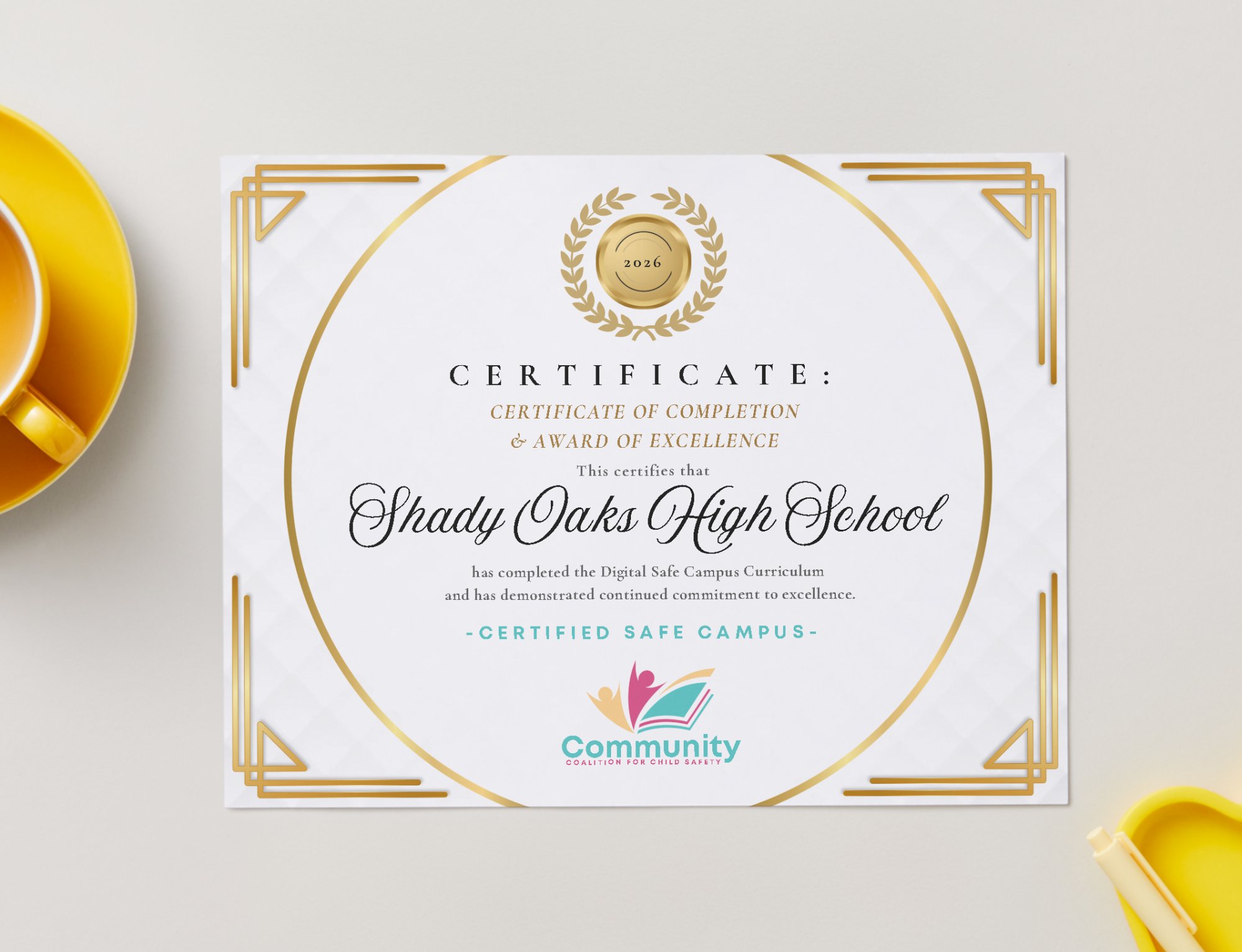
CCFCS Certified Safe Campus Certificate — Example showing Shady Oaks High School

Recognition that means something.

  • 🏆 Official Certification — Formal certificate of completion and award of excellence at your earned tier level.
  • 📊 Impact Report — Detailed data report showing measurable growth across all five domains with year-over-year tracking.
  • 🛡️ Certified Safe Campus Badge — Digital badge for your website, communications, and enrollment materials.
  • 📢 Public Recognition — Featured on our Certified Schools directory and eligible for community press coverage.
  • 🔄 Annual Renewal Pathway — Structured recertification process to maintain and advance your tier level each year.
Building protection from every direction.
When we certify a school, the impact reaches every layer of the community.
🎓

Students

Gain skills to recognize threats, set boundaries, and know how to report safely.

👪

Parents & Families

Build digital literacy and calm, supportive response strategies at home.

👩‍🏫

Educators & Staff

Receive trauma-informed training and clear protocols for handling disclosures.

🏛️

Districts & Administrators

Gain documented compliance, measurable data, and community trust.

How it works: a 6-month journey.
Our pilot model demonstrates measurable improvement in student safety, staff readiness, and institutional accountability.
5
Target Schools
4,000+
Students Reached
200
Staff Trained
800
Parents Engaged
Phase 1–2

Staff Training & Student Delivery

Educator trauma-informed response modules followed by student curriculum delivery across middle school and teen tracks.

Months 1–3
Phase 3–4

Parent Engagement & Infrastructure

Parent education sessions, resource hub access, and documentation of reporting pathways and protocols.

Months 3–5
Phase 5

Data, Certification & Recognition

Post surveys collected, impact report generated, certification scored, and public recognition awarded.

Month 6
We don't just deliver awareness. We measure change.
Every program element is designed to produce trackable, reportable outcomes across time.
0–6 Months

Short-Term Outcomes

  • Increased red flag recognition in students
  • Increased boundary and reporting confidence
  • Increased privacy literacy and peer awareness
  • Increased adult confidence handling disclosures
6–18 Months

Intermediate Outcomes

  • Improved school-wide reporting culture
  • Earlier disclosure of unsafe situations
  • Increased parent-student digital communication
  • Strengthened trauma-informed response systems
2–5 Years

Long-Term Impact

  • Normalized digital boundary culture
  • Reduced vulnerability to grooming and exploitation
  • Sustainable, scalable prevention infrastructure
  • Informed contributions to broader safety policy
Benchmarks

Target Metrics

  • 35% increase in student reporting confidence
  • 42% increase in trusted adult disclosure willingness
  • 60% parent participation in engagement sessions
  • 80%+ trusted adult identification rate
Certification funds the mission — not profits.
Revenue from professional training and school certification is reinvested into free student curriculum access and underserved community implementation.
🎓

Free Student & Parent Access

Core curriculum content is always free. Paid certification revenue enables this access for every community.

🏘️

Underserved District Support

Sliding scale and scholarship models ensure districts with limited budgets can participate fully.

📈

Reinvested Growth

All surplus is reinvested into curriculum development, platform hosting, and expanding reach to new communities.

🤝

Accountability & Transparency

As a program of a 501(c)(3) nonprofit, all financials are publicly reported and mission-aligned.

Ready to become a Certified Safe Campus?

Join our pilot program and build a measurable safety standard your community can trust.

Start the Conversation →